
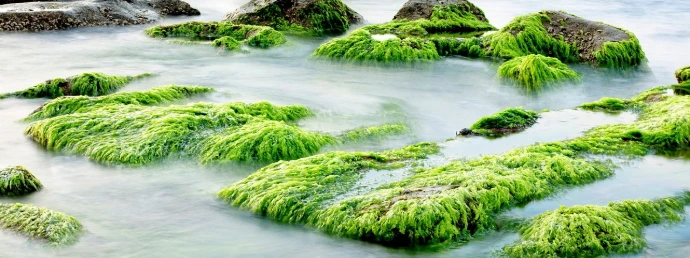
What the algae can do
We explore the question of what Chlorella actually is, what nutrients it provides, and what to consider when taking it.
Suitable products
Chlorella, Spirulina – all algae?
Maybe you have heard of Chlorella, Spirulina, AFA algae. You think these are all different types of algae? No, not quite. Strictly speaking, only Chlorella is an algae; the other two are bacteria, but they are often grouped with algae.
Chlorella is a single-celled green freshwater algae that has likely existed for over 2 million years. Historically, it was only recently discovered that it has a very high nutrient density and contains many proteins and essential amino acids. Additionally, Chlorella can support detoxification processes.
Ingredients of Chlorella
The rich dark green color of Chlorella already reveals one of its most important ingredients: chlorophyll, the plant hemoglobin. It has blood-forming and antioxidant effects, for example.
The green algae is also a leader in terms of protein content. It consists of about 60% proteins and even many essential amino acids. Iron (about 120 mg per 100 g) is also strongly represented, but magnesium, calcium, phosphorus, zinc, and manganese are included as well.
According to more recent study results it is one of the few plant-based sources of vitamin B12 (cobalamin) that can be well absorbed by the organism. With about 100 micrograms per 100 g, the B12 content is even relatively high. This is also the reason why Chlorella is an interesting food for vegetarians and vegans, as they often have a vitamin B12 deficiency due to their meatless diet.
Is Chlorella suitable for detox?
Absolutely! From its occurrence in nature, it is known that the spherical algae Chlorella binds heavy metals from the waters in which it lives due to the structure of its cell membrane. This function can also be exercised in our organism.
However, it must be said that this function has not yet been sufficiently proven by significant studies, although much indicates it. The large binding surface of the algae is utilized. This allows it to absorb pollutants that are excreted through regular digestion. Sufficient fluid intake and movement are important in any detox process.
What to pay attention to when taking it
Purity: The ability to bind heavy metals can quickly be harmful to our organism, if it is not ensured that it is a high-quality, pure Chlorella product. For nutrition or as a supplement, you should ideally use cultivated organic algae.
Dosage: In general, Chlorella is well tolerated and cannot be easily overdosed. We recommend 3-10 grams per day, divided into two to three doses. If headaches, nausea, diarrhea, or similar symptoms occur, it may be due to the detoxifying effect of the algae, or to an intolerance or overdose. In any case, the intake should be temporarily suspended and then cautiously resumed with a lower dose. To be on the safe side, also consult your doctor or therapist.
Targeted intake of proteins, iron, and vitamin B12. As mentioned, Chlorella is particularly important for people with a predominantly or entirely meatless diet as a source of nutrients. To consume a daily amount of 3-10 grams, Chlorella powder or tablets are suitable. These can be easily taken with water or added to smoothies.
Smoothie recipes
Green smoothies are "bio-hacking" active. Chlorella algae (for example, in the form of tablets) are also great for this.
Here you will find our 3 favorite recipes: "Bio-hacking active with Green Smoothies". It's worth trying!